
18 Aug 2016, 10:31 am

The discovery draws startling conclusions about how these early humans subsisted in a very demanding habitat, thousands of years before Homo sapiens first evolved in Africa.
New research published in the Journal of Archaeological Science by a team led by paleoanthropologist April Nowell of the University of Victoria reveals surprisingly sophisticated adaptations by early humans living 250,000 years ago in a former oasis near Azraq, Jordan.
The findings suggest these early Stone Age hominins were eating a range of meats, and were particularly partial to horse, rhino and duck.
A team from the University of Victoria, working with researchers in Jordan and the US, unearthed 10,000 stone tools during a three-year excavation in the deserts northwest of the town of Azraq.
While the region is dry and arid today, hundreds of thousands of years ago it is believed to be the site of wetlands – ideal hunting grounds.
They found that several of stone tools excavated at the site bore traces of animal protein - residues of blood, skin and flesh from the butchering process.
According to scientists, the discovery could be the oldest evidence of animal protein ever found and hints at sophisticated behavioural adaptations from these early hominins.
The team excavated 10,000 stone tools over three years from what is now a desert in the northwest of Jordan, but was once a wetland that became increasingly arid habitat 250,000 years ago.
The team closely examined 7,000 of these tools, including scrapers, flakes, projectile points and hand axes (commonly known as the "Swiss army knife" of the Paleolithic period), with 44 subsequently selected as candidates for testing.
Of this sample, 17 tools tested positive for protein residue, i.e. blood and other animal products.
"Researchers have known for decades about carnivorous behaviours by tool-making hominins dating back 2.5 million years, but now, for the first time, we have direct evidence of exploitation by our Stone Age ancestors of specific animals for subsistence," said Nowell.
"The hominins in this region were clearly adaptable and capable of taking advantage of a wide range of available prey, from rhinoceros to ducks, in an extremely challenging environment."
"What this tells us about their lives and complex strategies for survival, such as the highly variable techniques for prey exploitation, as well as predator avoidance and protection of carcasses for food, significantly diverges from what we might expect from this extinct species," continued Nowell.
"It opens up our ability to ask questions about how Middle Pleistocene hominins lived in this region and it might be a key to understanding the nature of interbreeding and population dispersals across Eurasia with modern humans and archaic populations such as Neanderthals."
Another result of this study is the potential to revolutionize what researchers know about early hominin diets.
"Other researchers with tools as old or older than these tools from sites in a variety of different environmental settings may also have success when applying the same technique to their tools, especially in the absence of animal remains at those sites," added Nowell.
- Amsterdam plans huge tourist tax hike — Visitors could soon pay up to 20 percent
- Germany waives airport Transit Visa requirement for Indian nationals from June 3
- Anand Mahindra amazed by Vande Bharat's journey across Chenab Rail Bridge
- Passengers urged to document luggage amid Canadian airport drug-tag scheme
- South Africa Goes Visa-Free for Indians, But There’s a Catch
- From War Risks to Medical Bills: Why Indian Travellers Need Better Travel Insurance
- Beyond Books – A College Street Heritage Walk to Trace Kolkata’s Literary and Academic Legacy
- Rare Pahari Art from India’s Himalayas Finds a Home at Smithsonian Museum
- Dubai Unveils Its First Fully Private Beach for Women
- Banksy’s Latest Work Pops Up in London, Sparks Midnight Buzz



Air India and Riyadh Air have signed a Memorandum of Understanding (MoU) as they look to strengthen links between their networks and offer travellers more convenient connections between India, Saudi Arabia and destinations beyond.
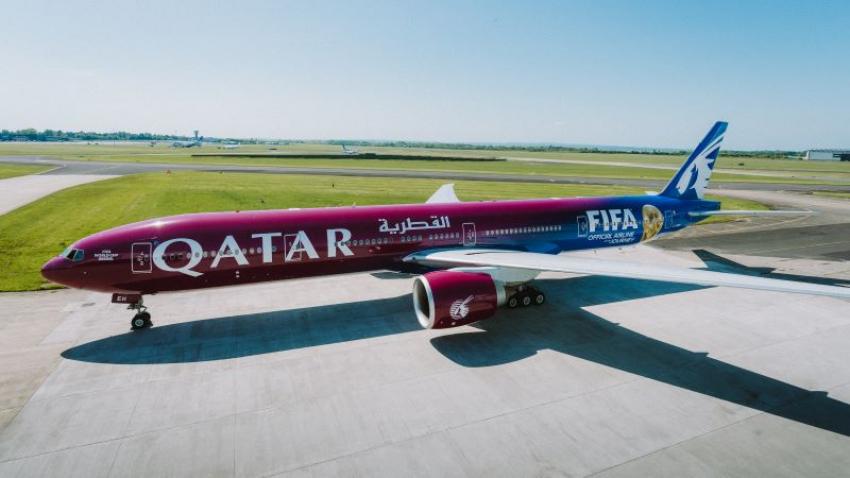
Qatar Airways has launched a Boeing 777 aircraft featuring a special FIFA World Cup 2026 livery, reflecting its ongoing association with FIFA. The aircraft has been unveiled ahead of the tournament and highlights the airline's role in connecting fans, teams, and football communities around the world.

Air India Express announces the launch of its ‘Xpress Sale,’ offering 5 million seats with savings of up to 50% on Lite (Zero Check-in Baggage) and Value fares across its domestic and international network.